Is Huntsville AL Still Cheap in 2025?
Short answer: Yes; housing is the main place you’ll save, but many other day to day expenses in Huntsville, AL are at or above national averages. Below is a clear cost of living breakdown by category and suburb so you can set realistic expectations for your move.
Quick answer
- Housing is the biggest source of savings.
- Healthcare and dining can be as expensive or more expensive than the national average.
- Gas and property taxes are generally lower than most other metros.
- Your suburb choice determines whether your budget stretches or falls short.
Market snapshot and what averages mean
The commonly quoted averages can be useful but misleading. Payscale’s 2025 cost‑of‑living data and other reports present metro‑level figures that blend diverse neighborhoods, which can obscure significant local differences. A regional average does not reflect what a specific buyer will pay for a specific home in a specific neighborhood.
According to ValleyMLS/HAAR sales records for August 2025, the average sales price for Madison County, AL was $330,000; representative prices by area were Madison $485,000, Owens Cross Roads $410,000, Toney $290,000, and Hazel Green $285,000. These exact MLS figures matter because neighborhood‑level price variation is the rule, not the exception.
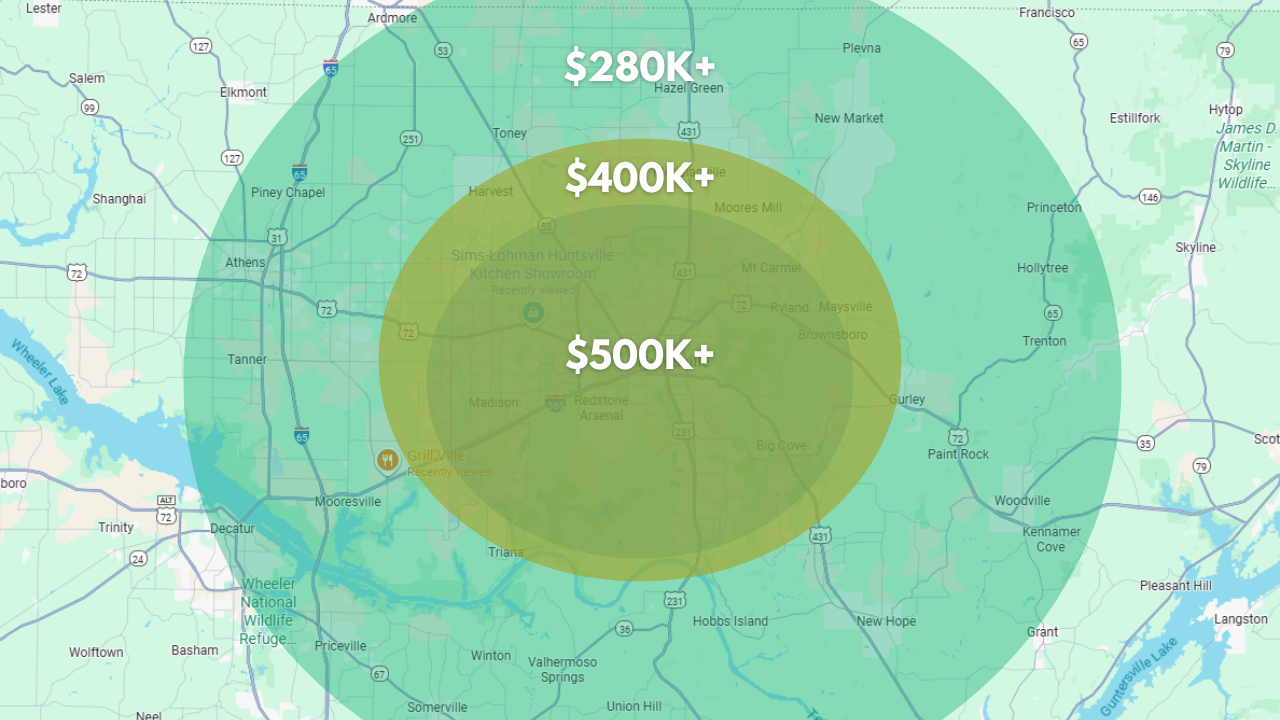
Huntsville metro map with colored rings showing median home prices by suburb (ValleyMLS/HAAR, Aug 2025).
Sources: ValleyMLS/HAAR (Aug 2025); Payscale 2025 cost‑of‑living data; Previous Huntsville cost breakdown.
Housing by ring and sample price points
Think of the area in three rings:
- Center Ring — Huntsville and Madison
- Pros: short commutes to Redstone Arsenal and Research Park, top amenities, stronger school options.
- Cons: highest prices; expect to pay above the regional average (see Madison figure above).
- Secondary Ring — Harvest, Hazel Green, New Market, Owens Cross Roads
- Pros: more affordable than the center, reasonable amenities.
- Cons: longer commutes and variable school quality in some pockets
- Tertiary Ring — Athens, Ardmore, Toney, Arab, Rogersville
- Pros: lower list prices in many neighborhoods; some areas still offer sub‑$300k homes.
- Cons: significant commute times; places like Athens are seeing faster price gains.
Internal resources: Move to Huntsville hub; Previous detailed housing analysis.
Cost of living beyond housing
- Gasoline
Gas prices in many parts of Alabama run below national peaks, which helps commuters; check current averages at AAA’s gas prices site for trending context (AAA Gas Prices). - Taxes
Alabama’s property tax burden is typically lower than many states, which reduces ongoing homeownership costs; see the state comparison at Rocket Mortgage (Property Taxes by State). - Groceries and dining
Many grocery and restaurant prices are in line with national averages. Huntsville’s affluence supports many higher‑end dining options that can be pricey. If you rely on frequent inexpensive quick‑grab meals, you may find fewer sub‑$10 options than in larger metros. For a family of four, a casual meal out often exceeds $100 pre‑alcohol. - Healthcare
Healthcare costs can surprise newcomers; local provider networks, co‑pays, and in‑network status vary by plan. Tricare beneficiaries should confirm networks and availability in advance and consider bringing a 30‑day supply of daily meds when they move. Use Humana Military’s provider finder for network checks and plan navigation (Humana Military Find Care).
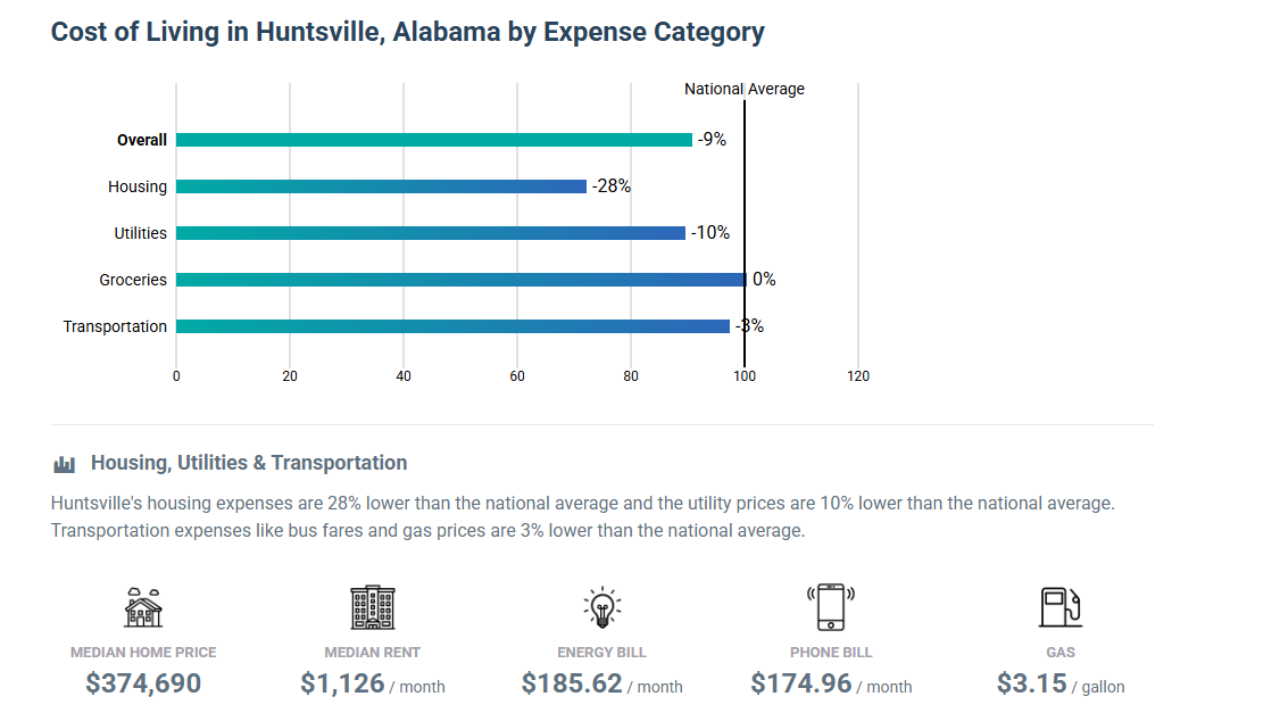
For quick cost‑of‑living comparisons, BestPlaces offers city‑level indices that illustrate how Huntsville stacks up to national averages (BestPlaces Huntsville cost of living).
Who saves the most and who may pay more
- Likely big winners: People relocating from coastal high‑cost metros (San Francisco, Los Angeles, NYC). You’ll typically get much more home and land for your budget.
- Less of a win: Households moving from lower‑cost Midwestern suburbs while insisting on short commutes, top schools, and new large homes in Madison or Huntsville; those preferences can push budgets higher than expected.
Practical tactic: prioritize neighborhoods with built‑in amenities (pools, trails, playgrounds) and reasonable HOA fees (many around $500/year) to substitute for paid entertainment and reduce monthly discretionary spending.
Image alt text suggestion: Collage of neighborhood amenities — pool, walking trail, playground, tennis court.
Practical moving and budgeting advice
- Book a short relocation consultation to map your priorities to realistic suburbs and price ranges.
- If you need daily prescriptions, bring a 30‑day supply and establish care with a local provider promptly; use the Humana Military find‑care tool for Tricare/VA checks (Humana Military Find Care).
- Evaluate total cost, not just list price: include insurance, property taxes, commuting fuel and time, childcare, and dining habits.
- Use the three‑ring framework to compare tradeoffs between commute, schools, and home size.
Frequently asked questions
- Can I find a livable $200,000 home in Huntsville?
It’s possible but uncommon and usually involves compromises on location, condition, or commute. Inventory in that price band is limited; exercise caution and insist on full inspections. - Is Huntsville cheaper than New York or California?
Yes, especially for housing; you’ll usually get more home for your money compared to major coastal metros. - Is healthcare expensive here for Tricare users?
Network availability varies. Confirm in‑network providers before moving; some Tricare users report longer waits for certain specialists, while VA access is generally well‑regarded locally. - Do I save on property taxes?
Alabama’s property taxes tend to be lower than many states, which helps reduce ongoing homeownership costs (Property Taxes by State). - Where will $300,000 buy the most?
In 2025 that budget stretches further in outer suburbs and tertiary‑ring towns; in Madison and parts of Huntsville you’ll likely need a higher budget (see ValleyMLS/HAAR Aug 2025 figures above: HAAR Aug 2025).
(Updated Saturday, Oct 18th, 2025)
Conclusion
The “affordability myth” isn’t that Huntsville isn’t affordable — it’s that affordability isn’t uniform. Housing is the primary source of savings, but many other costs hover near national averages or exceed them depending on your needs. Choose the correct suburb for your priorities rather than assuming a regional average will match your household’s reality.
We can help lay out realistic options for your budget and priorities. Book a free 15‑minute relocation call or reach out with questions.
Disclaimer: Cameron Walker Realty is an independent real estate brokerage. This information is for general guidance and may not apply to all individual situations.
Sources and further reading
- Payscale — Huntsville cost‑of‑living calculator (2025): https://www.payscale.com/cost-of-living-calculator/Alabama-Huntsville
- ValleyMLS / HAAR — August 2025 market report: https://haar.realtor/aug25/
- Humana Military — Find care (Tricare resources): https://www.humanamilitary.com/beneficiary/findcare
- AAA — gas prices: https://gasprices.aaa.com/
- Rocket Mortgage — property taxes by state: https://www.rocketmortgage.com/learn/property-taxes-by-state
- BestPlaces — Huntsville cost of living: https://www.bestplaces.net/cost_of_living/city/alabama/huntsville
Internal links
- Previous article: Huntsville housing 2025 — over‑priced or rebalancing: https://www.cameronwalkerrealty.com/blog/huntsville-housing-2025-overpriced-or-rebalancing-what-relocating-buyers-need-know/
- Move to Huntsville hub: https://www.cameronwalkerrealty.com/move-to-huntsville/